
Way Up High – Denver’s Music Scene and Alfred E Neuman
By Garrett Schroeder, Graduate Class of 2027
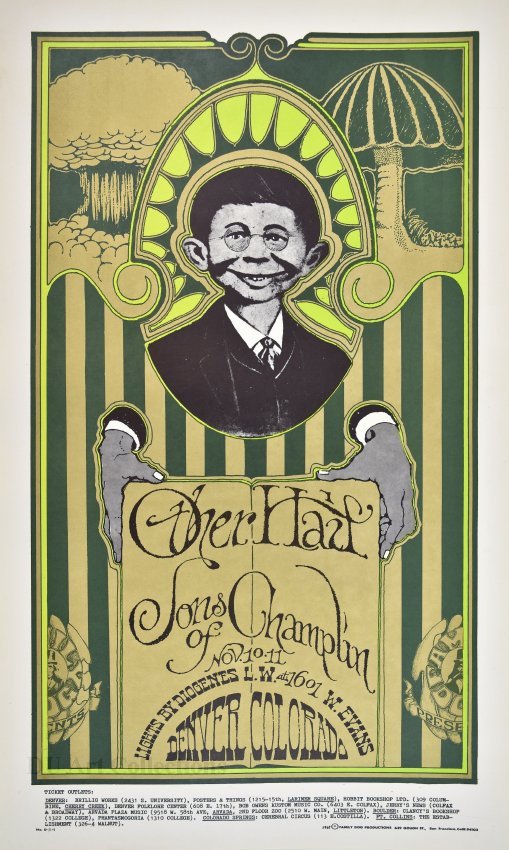
Best known for their work making posters advertising concerts in the San Francisco Bay area, Alton Kelley and Stanley Mouse created this design advertising a two-night show at the now-defunct Family Dog music Venue in Denver. This show featured The Other Half and Sons of Champlin, two popular rock bands who were active mainly in San Francisco but had traveled to Denver with the promise of a burgeoning music scene.
As equal partners, Kelley designed the layout, while Mouse did the drawing and coloring. The duo often appropriated images for use in their posters from magazines or old history books. This poster uses an adapted image of the character Alfred E. Neuman, the face of MAD magazine, whose image was often associated with a sense of humor due to the publication being satirical in nature. In the background, Kelley and Mouse placed two mushrooms–a mushroom cloud and a hallucinogenic mushroom–invoking Psychedelic counterculture imagery synonymous with the 60s due to their ties with both drugs and the Vietnam War.
While many of the other posters created for the Family Dog were designed with Psychedelic motifs, this poster leaned much more heavily on Art Nouveau inspiration, with straight-edge borders and legible lettering, in contrast to its sibling posters, which often held the opposite. Art Nouveau was an artistic style that flourished from the late 19th to the early 20th centuries, which focused on bringing together “high” artistic forms in “lower” everyday objects, such as furniture, architecture, and posters. Mouse and Kelley’s use of Art Nouveau style was deliberate, calling back to the elevation of the poster as an art form.
Despite the formality of the poster’s design, Alfred E. Neuman’s image and personality suggest that individuals attending could get their fix of illegal substances such as LSD (commonly known as acid), key to the counterculture, and their musical experience. Alfred is also notably holding open the music shows in his hand as if they are being offered on a menu, further tying the idea that this jolly prankster is inviting the viewer to join him in the experience of these two music shows.
While the Denver location would only last a year, concerts at the Family Dog Denver would later pave the way for a greater music scene in Colorado, with posters like the ones created by Kelley and Mouse becoming equivalent with the rock and roll music scene. Successful shows such as this one proved that Denver was a prime location for a burgeoning music culture, although it wasn’t until years later that it started to finally flourish.