
Colorado’s Forgotten Printmakers: The Sterling Project
By Elaina Flemming, Graduate Class of 2027
In 1935, the Works Progress Administration (WPA) created the Federal Art Project (FAP), which gave artists jobs and opportunities to uplift their communities with murals, posters, and other public art projects. The WPA branch of Colorado collaborated with the State Historical Society to fund what was colloquially known as the Sterling Project, a series of over fifty commissioned woodblock prints meant to be disseminated to Colorado educational institutions. The Colorado State Historical Society later grew into the History Colorado museum, the home of many of the prints from this series.
The Sterling Project’s woodblock designs were created by a team of artists, most notably William Traher and Harold Keeler, and comprised two main sets of themes. Named by supervisor Edgar McMechen, the Colorful Periods of Colorado History series focused on agriculture and homesteading, American fur traders and the beaver trapping industry, Spanish colonialism or the “Mixing of Races,” and Manifest Destiny or the “Great White Migration.” The second was the Growth of Civilization series and featured scenes of Native American life and the ancestral Pueblo people of Mesa Verde.
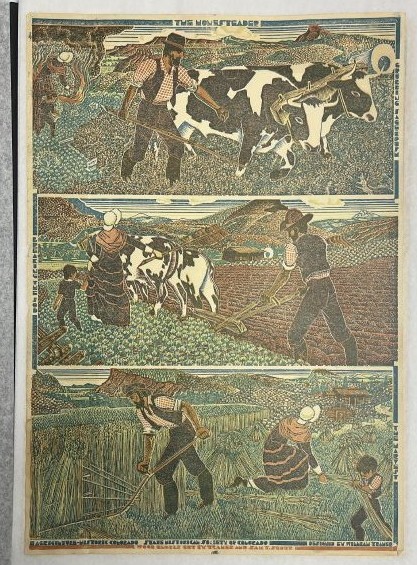
The art produced during this time furthered a growing interest in a uniquely American art style known as the “American Scene.” American Scene artists created accessible pieces that were largely split up into two categories: American Regionalism and Social Realism. American Regionalism celebrated the country with idealistic portrayals of rural local scenery, community, and progress. Agriculture was a very common subject for American Regionalism as it allowed artists to express important parts of their local communities, contributing to the idealization of homesteading, the tending of your own land. Traher’s works for the Sterling Project largely reflected these ideas, like in The Homesteaders, which emphasizes the importance of family and their division of labor.
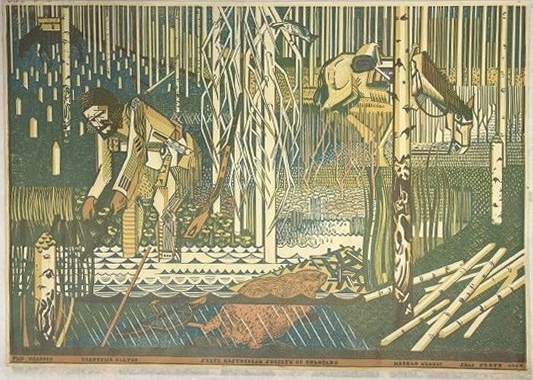
Keeler’s style was different, though, in both his color choices and the way he rendered his figures and lines more geometrically. In Keeler’s The Trapper, Trapping Beaver, the trapper and his horse are much more modular in form than Traher’s farmer and landscape, demonstrating a precursor to later American modernism.
It seems like Keeler might have been practicing perspective as the horse and beaver are both partially cut off by their environment, the tree and river, respectively. In his work, rather than looking out at the horizon like in Traher’s, the scene is focused downward on the beaver in his river and the greater forest area.
All of Traher and Keeler’s prints were carved by the same man, Sam T. Scott. Without his carving ability, Traher and Keeler’s designs would be completely different and wouldn’t have half the impact that comes from the small carved details.
Most of the art created for the WPA has been under-researched, and the printmaking that came out of the FAP has especially been overlooked. These works have been cast aside as public art created for educational purposes and not considered as the valuable pieces of American art history that they are. These artists and their works stand out from the rest of the Sterling Project because they’re not just representing periods of Colorado history; they’re also demonstrating characteristics of some of the greater art styles happening during the Great Depression.