
Chagoya’s Take on Superheroism
By Amelie Satterwhite, Graduate Class 2027
Mexican born artist Enrique Chagoya is primarily a painter and printmaker, yet he also engages in ‘reverse anthropology.’ The idea of ‘reverse anthropology’ Chagoya describes as “an antithesis of modernist strategies of appropriation,” appropriating and “cannibalizing” Western- European and American works of art for himself.[i]
Among the University of Denver’s recent acquisitions is Chagoya’s 1999 print Les Aventures des Cannibales Modernistes. Among his growing collection of accordion-styled codex works, the lithograph is printed using a chine collé process.[ii] Chagoya writes that in his work he enjoys using “many interacting elements from different historic times and places that collide with each other. Cultural symbols, religious icons, ethnic stereotypes, and whatever crosses my mind that may make some kind of short circuit in someone’s mind—a thesis, an antithesis, and the synthesis.”[iii]
His varying imagery of pre-Columbian art, modern advertising, European classical art, and comics is a visualization of this “cannibalizing” of Euro-American imagery.[iv] Appropriating these images serve as a form of indigenous resistance to the cultural and historical sacking of Latin America by early Spanish settlers, but they go beyond decentering these images.[v] As anthropologist Dana Leibsohn comments, Chagoya’s “cannibalizing” images move to “reverse, if not overturn, the direction of influence in Western art.”[vi]
Les Aventures des Cannibales Modernistes (translating to The Adventures of the Modernist Cannibals) provides this visual synthesis and cannibalization of imagery, in addition to an interesting introspection into Chagoya’s specific usage of popular American comic book characters. Superheroes, scholar José Alaniz writes, “have come to represent the exuberant optimism as well as latent violence of mainstream America.”[vii] Their popularity, however, makes them useful figures for BIPOC artists to co-opt, appropriate, and subvert the ideas of as they are ideologically redefined.[viii]
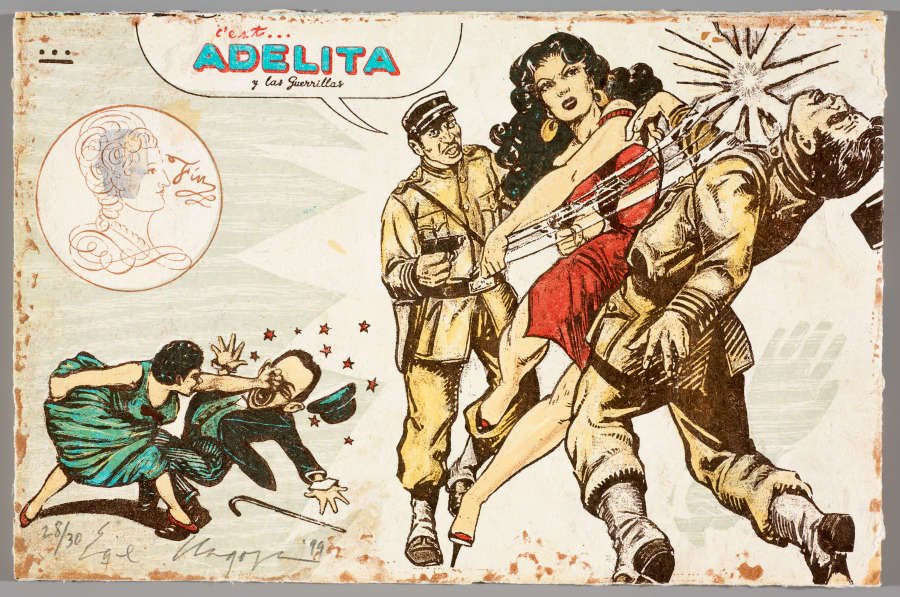
Within Les Aventures des Cannibales Modernistes Superman and Captain America serve as the antagonists of Chagoya’s narrative, with images of the 1936 Mexican comic heroine Adela Negrete from José Cruz’s series Adelita y las Guerrillas fighting in defense of the indigenous people.[ix] Adelita appears in the first panel of the codex, delivering a sharp punch to the face of a Mexican military official. She is introduced to us by the shocked officer behind her, going “c’est…. Adelita y las Guerrilas.” Her title translating directly to “Adelita and the Female Soldiers.” She served as both a Mexican heroine of the revolution and argued for the “chica moderna,” the modern Mexican girl who wanted autonomy and excitement in her life.[x]
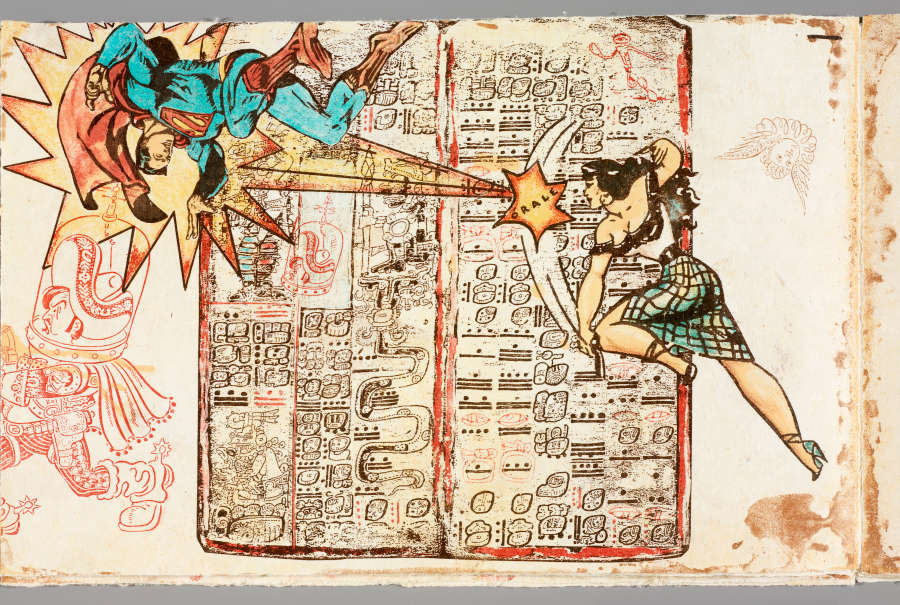
We next see Adelita on the fourth panel as she punches DC’s Superman across the panel with a quick “órale,” the force throwing Superman across a Mayan codex page. Superman is evidently the villain in this scene. Although the reasoning is unclear, it can be inferred that Adelita’s presence as Mexico’s heroine places the white superhero as a threat to Mexico and Mesoamerican history. Is the man of steel a colonizer within Chagoya’s world?
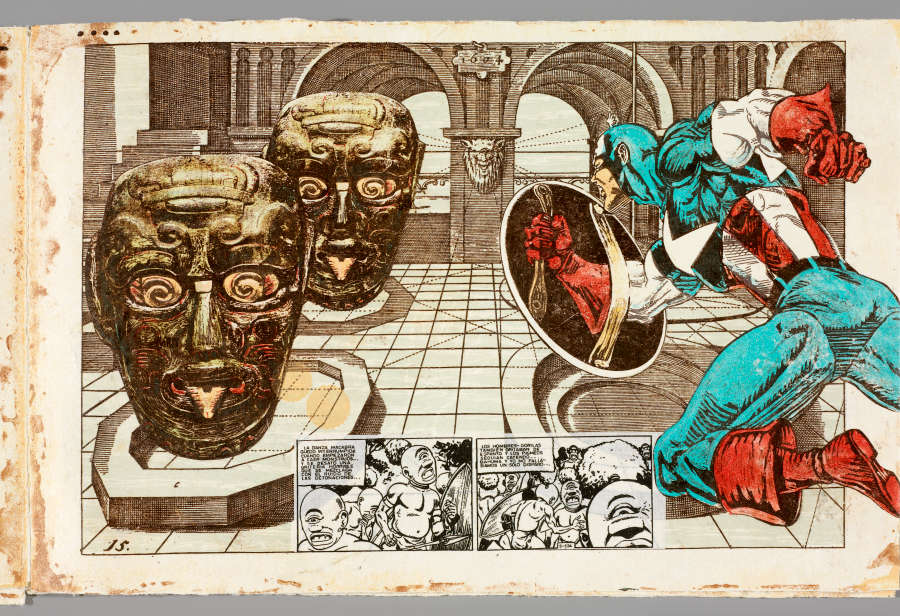
The other freedom loving American superhero within the codex, Marvel’s Captain America, seems to confirm this villainy. Appearing on the seventh panel of the codex, Captain America charges angrily across the panel towards a pair of enlarged standing indigenous masks. Although the context for why Captain America is doing this is not provided, nor are the masks given any identification, the superhero surges forward as if to break the two objects.
Chagoya’s reinvented history of events, where the Superhero becomes the Supervillain, is rooted in his larger analysis of the effects of colonialism and hybrid identity. Chagoya writes about his alternate histories, “often the white superheroes… in my work represent the Western cultural colonialism expanding not only in the Americas but all over the world.”[xi] Chagoya’s superheroes thus serve less as simple decoration within his prints, but a representation of the threat of white cultural hegemony and the experiences of colonialism.
[i] Enrique Chagoya and Peter Nesbett, “Laughing at a Bad Dream,” Art on Paper 13, (2008): 27.
[ii] Sarah Kirk Hanley, “Visual Culture of the Nacirema: Enrique Chagoya’s Printed Codices,” Art in Print, no. 6 (2012): 4.
[iii] Chagoya and Nesbett, “Bad Dream,” 26-27.
[iv] José Alaniz, “Whiteness and Superheroes in the Comix/Codices of Enrique Chagoya,” in Unstable Masks: Whiteness and American Superhero Comics, ed. Sean Guynes and Martin Lund (The Ohio State University, 2020), 106.
[v] Alaniz, “Comix/Codixes of Enrique Chagoya,” 106.
[vi] Alaniz, “Comix/Codixes of Enrique Chagoya,” 106.
[vii] Alaniz, “Comix/Codixes of Enrique Chagoya,” 104.
[viii] Alaniz, “Comix/Codixes of Enrique Chagoya,” 104.
[ix] Anne Rubenstein, Bad Language, Naked Ladies, and Other Threats to the Nation: A Political History of Comic Books in Mexico (Duke University Press, 1998), 21.
[x] Rubenstein, Political History of Comic Books in Mexico, 22.
[xi] Alaniz, “Comix/Codixes of Enrique Chagoya,” 119.
Alaniz, José. “Whiteness and Superheroes in the Comix/Codices of Enrique Chagoya.” In Unstable Masks: Whiteness and American Superhero Comics, edited by Sean Guynes and Martin Lund. The Ohio State University, 2020.
Chagoya, Enrique and Peter Nesbett. “Laughing at a Bad Dream.” Art on Paper 13, (2008): 26-28.
Hanley, Sarah Kirk. “Visual Culture of the Nacirema: Enrique Chagoya’s Printed Codices.” Art in Print, no. 6 (2012): 3-15.
Rubenstein, Anne. Bad Language, Naked Ladies, and Other Threats to the Nation: A Political History of Comic Books in Mexico. Duke University Press, 1998.